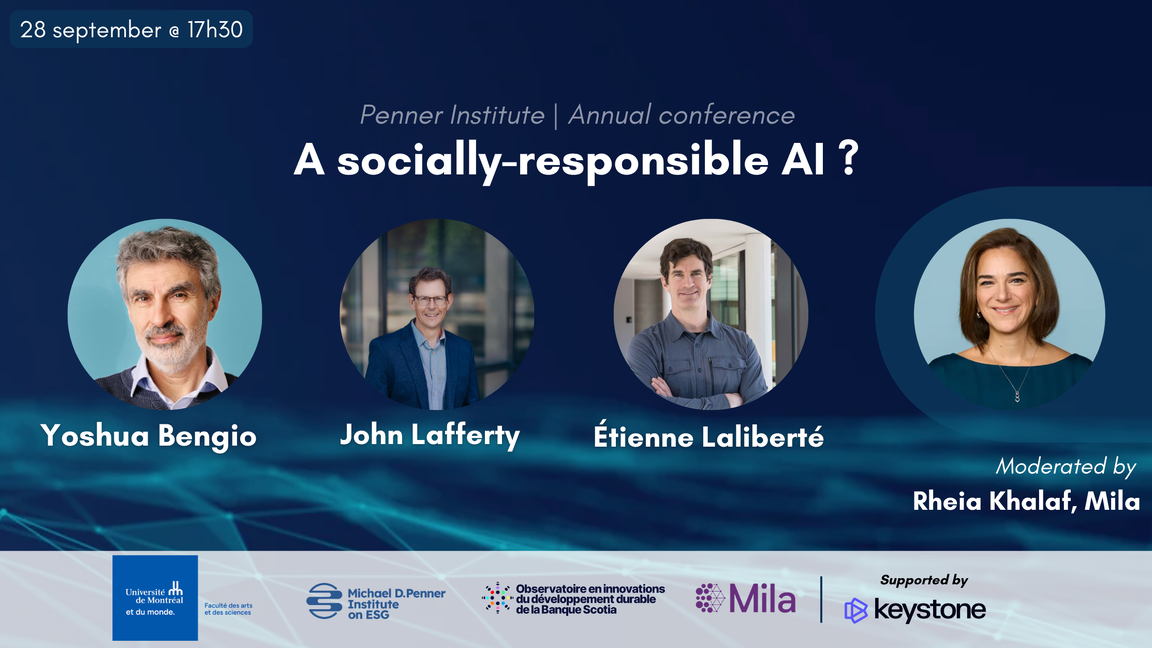

A socially-responsible AI?
Institut Penner sur les enjeux ESG présentent

A socially-responsible AI?

Événement en personne
28 septembre 2026
17h30 – 19h00

6666 rue Saint-Urbain, Montréal, QC, Canada
Lepointdevente.com agit à titre de mandataire pour Institut Penner sur les enjeux ESG dans le cadre de l’affichage en ligne et la vente de billets pour ses événements.
Pour plus d’information à propos de cet événement, veuillez contacter l’organisateur de l’événement, Institut Penner sur les enjeux ESG, à institutpenner@umontreal.ca.

Achat de billets

Environmental, Social, and Governance (ESG) considerations have been gaining ground in organizational settings over the past two decades. Consequently, the development and use of AI by companies raise a multitude of ESG and ethical issues: privacy, intellectual property, bias, impacts on the labor market, GHG emissions and resource consumption, energy costs, the construction of data centers in local communities, and more. But how can organizations leverage AI to fulfill their societal responsibilities? Is its development socially responsible? And what is its potential for social progress and environmental protection?

Vérification des disponibilités en cours...

Environmental, Social, and Governance (ESG) considerations have been gaining ground in organizational settings over the past two decades. Consequently, the development and use of AI by companies raise a multitude of ESG and ethical issues: privacy, intellectual property, bias, impacts on the labor market, GHG emissions and resource consumption, energy costs, the construction of data centers in local communities, and more. But how can organizations leverage AI to fulfill their societal responsibilities? Is its development socially responsible? And what is its potential for social progress and environmental protection?

Yosha Bengio

Yoshua Bengio is Full Professor of Computer Science at Université de Montreal, Co-President and Scientific Director of LawZero, as well as the Founder and Scientific Advisor of Mila. He also holds a Canada CIFAR AI Chair. Considered one of the world’s leaders in Artificial Intelligence and Deep Learning, he is the recipient of the 2018 A.M. Turing Award, considered to be the "Nobel Prize of computing." He is the most cited computer scientist worldwide, and the most cited living scientist across all fields (by total citations). Professor Bengio is a Fellow of both the Royal Society of London and Canada, an Officer of the Order of Canada, Officer of the Order of the British Empire, a Knight of the Legion of Honour of France, the Co-Chair of the UN’s Independent International Scientific Panel on AI, and Chair of the International AI Safety Report.

Étienne Laliberté

Étienne Laliberté is a full professor in the Department of Biological Sciences at Université de Montréal, a member of the Institut de recherche en biologie végétale (IRBV), and the Canada Research Chair in AI for the Environment. Laliberté’s current research focuses on the development of new approaches for vegetation monitoring (plant biodiversity and carbon) based on high-resolution remote sensing using drones and computer vision. He is particularly interested in applications of this technology that can help mitigate biodiversity loss and climate change, and that can have a rapid and widespread impact.

John Lafferty

John Lafferty is the John C. Malone Professor of Statistics and Data Science at Yale University. He also serves as Associate Director of Yale’s Wu Tsai Institute and Director of its Center for Neurocomputation and Machine Intelligence. Professor Lafferty is a pioneering figure in machine learning, language models, and the statistical foundations of artificial intelligence. His foundational research on conditional random fields, topic models, and graph-based learning has received several Test of Time awards. He also helped establish the United States’ first Machine Learning PhD program at Carnegie Mellon and has held appointments at the University of Chicago, Carnegie Mellon, Harvard, and the IBM Thomas J. Watson Research Center, where he worked on natural language processing, language modeling, and speech recognition. As a member of Yale’s AI Steering Committee, Professor Lafferty brings deep technical, applied, and institutional insight to questions of responsible AI governance. 

Moderated by Rheia Khalaf

Rheia Khalaf is the Director of Partnerships at Mila and a member of the Scientific Committee of the Michael D. Penner Institute on ESG.

She has more than 15 years of experience at the intersection of artificial intelligence, financial services and risk management. At Mila, she leads strategic partnerships with leading organizations, primarily across financial institutions and highly-regulated industries.

She is particularly interested in how organizations can harness increasingly capable AI to create long-term value while managing emerging risks and ensuring that technological progress delivers broad societal benefits. She previously held roles at IVADO, Fiera Capital, EY, and the Office of the Superintendent of Financial Institutions (OSFI).

She holds an M.Sc. in Quantitative Finance and Risk Management from the University of Zurich and ETH Zurich, a B.Sc. in Actuarial Mathematics from Concordia University, and is a Fellow of the Society of Actuaries and the Canadian Institute of Actuaries and a Chartered Enterprise Risk Analyst.

Événements à venir